Meaning Over Mechanics
The Weight of Gold
Awards don't create meaning - they document it. In film and marketing, the work that lasts is the work that carries weight after the push ends.
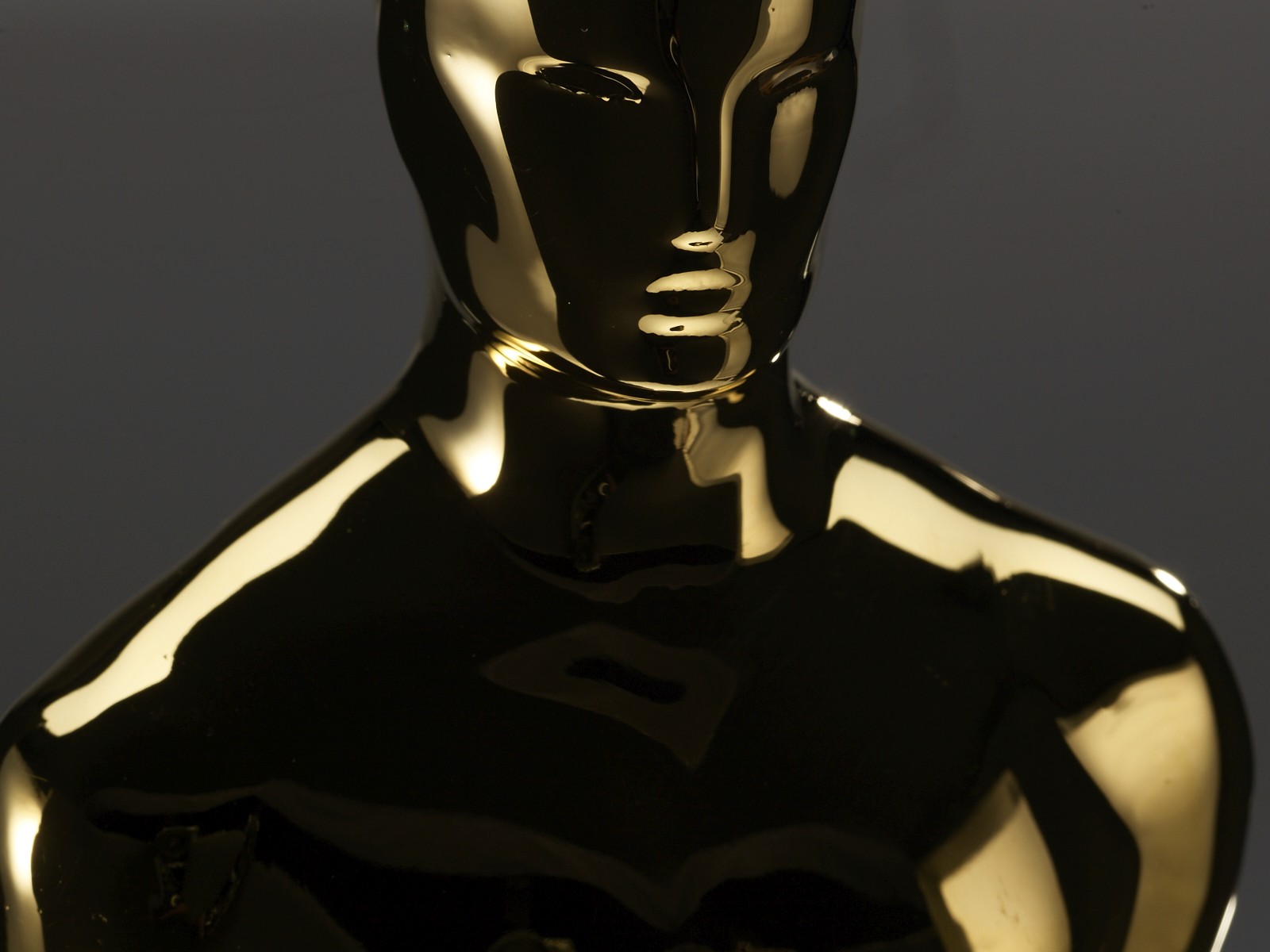
Awards season has a physical truth baked into it: the hardware is heavy. When we worked on the branding and marketing package for the Oscars, I remember holding the statuette and realizing the most impactful part wasn’t the symbolism — or even the amount of gold in my hands (or the security guards standing by) — but the weight. Not metaphorically.
It’s the kind of weight that makes you recalibrate your grip mid-pose. Your wrist adjusts, your shoulders square up, and you get this brief, private moment of realizing the object is doing part of the performance for you. It’s prestige you can feel in your bones, which is both ridiculous and… kind of perfect. (For the record, the Oscar statuette is 8½ pounds — which is the excuse I’m sticking with for the ‘why do I feel this in my abs?’ soreness the next morning. Obviously, the statuette, not me.)

Eight and a half pounds of 'don't drop it.'
Meaning is upstream. The trophy is downstream.
Here’s the thought I’ve been kicking around: awards don’t create meaning. They react to it — sometimes accurately, sometimes noisily, often late. A trophy doesn’t generate value; it records a moment when enough people agreed that something had it. And we do ourselves no favors when we start treating the record as the cause.
Because I’m incapable of leaving well enough alone, I’m going to name the two forces that keep getting tangled together this time of year:
Meaning: the cultural memory that stays when the push ends — why something is remembered, repeated, quoted, returned to.
Mechanics: everything that can amplify a message without improving it — media spend, distribution, PR, targeting, tooling, format velocity, and the scaffolding we build to make work look bigger than it is.
Awards season is where we mistake the trophy for the reason the work mattered, instead of the proof that it did.
Film, advertising, and the transparency of the transaction
Film gets to look you in the eye and say, “This is for you,” while quietly running the numbers behind the curtain — financing, packaging, release strategy, risk exposure, return.
Advertising has to say, “This is for you… and also buy this,” with the transaction printed on the label.
Advertising gets blamed for honesty. Film gets credited for discretion.
That single difference is why audiences reflexively treat film as “art” and advertising as “noise.” And this is going to irritate some of my filmmaker friends: advertising gets dismissed as disingenuous when it’s the one medium that openly admits what it’s doing. Film gets the luxury of keeping the commerce implicit — even when we’re literally buying a ticket to spend two hours inside an IP ecosystem.
Once you accept that, the wide shot gets clearer: both are built from the same raw materials — intention, structure, performance, pacing, image, sound, consequence — designed to make a person feel something, remember something, and choose something. And regardless of what each is selling — overtly or covertly — the craft problem doesn’t change: does the work carry weight, or is it merely polished enough to pass?
Production is abundant. Judgment is scarce.
This is also where awards season gets… charmingly inconsistent. Awards logic has its own weather system. How else do you explain One Battle After Another winning as a musical at the Golden Globes?
Still, separate the weather from the climate. Over time, the pattern is consistent: craft creates resonance. Distribution can amplify it — or disguise the lack of it. Awards don’t manufacture meaning; they signal where meaning seems to have landed.
Modern production reality: distribution is cheap, meaning isn’t
We’re living in a production reality where the bottleneck isn’t making things — it’s deciding what’s worth making in the first place.
It’s never been easier to ship work that looks finished: faster, in more formats, across more surfaces, with more tooling, targeting, automation, and optimization. The marginal cost of polish has collapsed. What hasn’t collapsed is the standard. We’ve always been able to manufacture “adequate”. What’s new is how quickly “adequate” can fill the world.
“Adequate” never earned cultural memory.
So volume isn’t the constraint. Judgment is. Taste is. The willingness to protect a standard when the machine offers shortcuts — that’s the competitive advantage now.
And this is the part people miss when they confuse output with effectiveness: when meaning isn’t doing the work, mechanics get promoted from amplifier to substitute. Media plans get heavier. PR gets louder. Distribution gets more aggressive. The narrative gets more engineered. You can absolutely win a weekend that way. You rarely win a decade.
Which is why I keep coming back to the simplest version of the rule: mechanics don’t create meaning; they rent attention.
Marketing is moving closer to film, on purpose
It’s fashionable to talk about “content” as if it’s new. What’s actually new is that brands have stopped pretending they’re only advertisers. They’re building entertainment strategies deliberately — film, TV, music, gaming, cultural collaborations — because they’ve learned what studios already know: attention is earned through story, not demanded through distribution.
This shift isn’t subtle. Gap Inc. just created a Chief Entertainment Officer role and hired Pam Kaufman to lead an “entertainment, content, and licensing” strategy across film, television, music, sports, gaming, consumer products, and cultural partnerships. That’s not a cute press-release flourish; it’s a public admission that brand is increasingly built with entertainment grammar, not just media weight.
And it’s not just fashion. iFIT launched Trainer Games as a reality competition series on Prime Video — with the cleanest kind of brand flywheel built in: viewers can later train with the winning coach through the subscription product. It’s entertainment, but it’s also product architecture.

Entertainment as product architecture.
The playbook has been around long enough to have history. BMW Films ran one of the earliest clean proofs with The Hire — cinematic shorts with serious talent, distributed online, and (by BMW’s own accounting) racking up more than 100 million views because they were worth watching on their own terms.
That’s why the “film vs. marketing” comparison isn’t a reach. It’s convergence. We already pay to sit inside IP ecosystems — sometimes openly (adaptations, franchises), sometimes quietly (product placement), often both at once. The question isn’t whether selling corrupts the work. It’s whether the work can still say something true while the selling is happening. And if you’re responsible for brand reputation, that’s not an abstract debate — it’s a durability test.
Alignment: when the wrapper proves the work knows what it is
Sometimes, a campaign makes the relationship between film and marketing so obvious that it’s almost rude.
The most useful example I’ve seen recently is Marty Supreme — not because the marketing was “clever,” but because it behaved like an extension of the work rather than a megaphone pointed at it. The staged Zoom “marketing meeting” didn’t feel like a trailer begging for attention. It was entertainment in its own right — tone, awkwardness, control, self-awareness — and, more importantly, a signal that the team understood the world they were inviting people into.
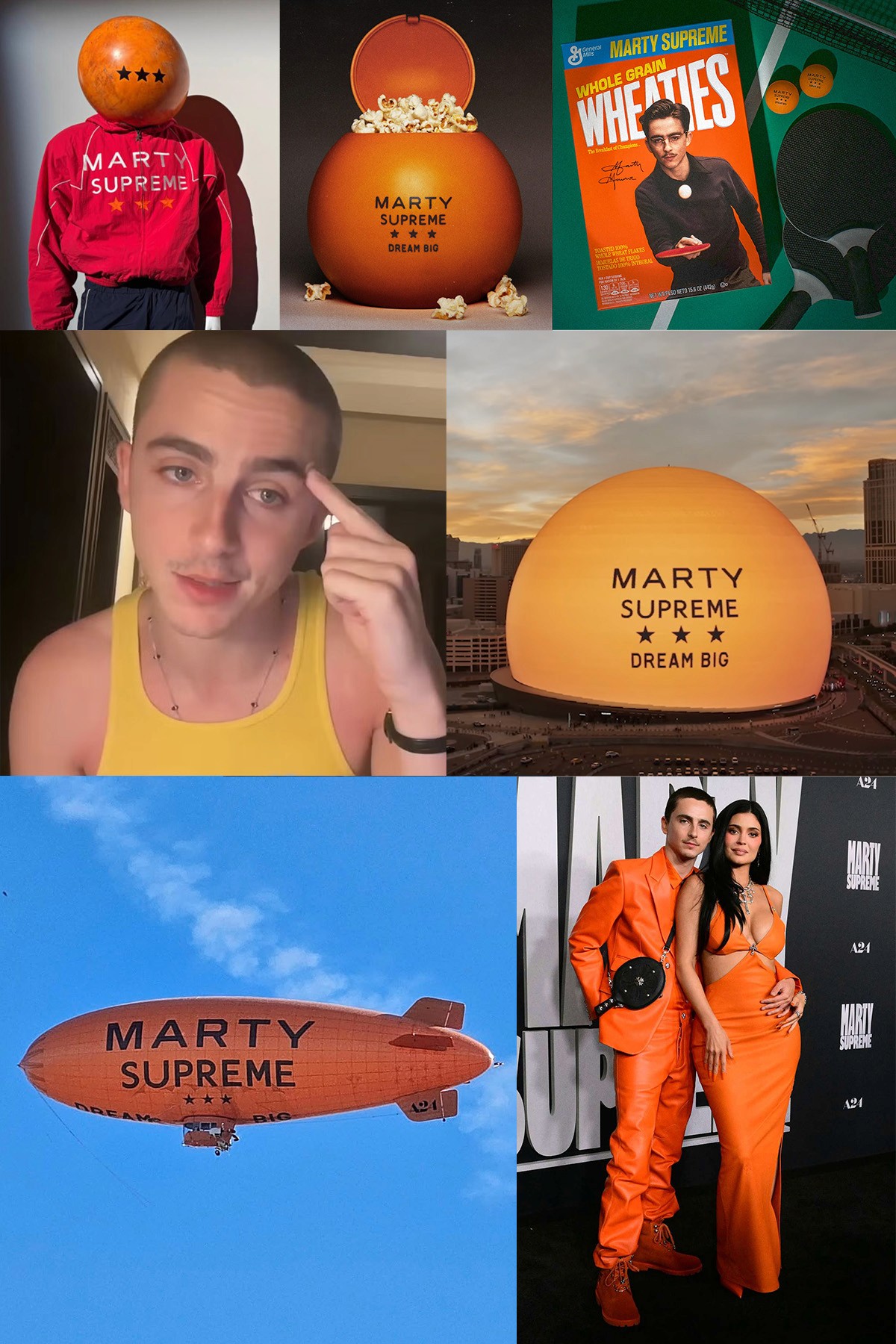
The wrapper becomes part of the world.
Then they took the joke out of the screen and put it in the world. The orange blimp wasn’t just a stunt; it was a reference. On its face, anyone could clock it as promotion — “okay, that’s for Marty Supreme.” But for the people who’d seen the “leaked” meeting, it landed differently. It turned into an IYKYK moment — something you could recognize, point at, share, and feel lightly inside of. Not because it was exclusive, but because it carried context.
Context turns promotion into participation.
That’s the difference between marketing that hustles and marketing that hosts. Context is the cheapest special effect we have, and we constantly underuse it. Traditional advertising is often forced into barker mode — look how much better this will make your life — because it has to sell fast, in public, with the transaction on the label. When you attach meaning — when you build a little shared language — you stop selling at people and start bringing them along for the ride.
And when marketing works like that, it doesn’t just move attention. It earns participation.
When mechanics try to replace meaning
Awards season doesn’t just reward work — it concentrates attention on the film business. And when attention concentrates, the industry’s optical illusions get easier to spot: a reputation product shows up with blockbuster mechanics, and people start confusing the size of the push with the weight of the work.
On January 30, Melania hit theaters with a reported $75 million all-in cost — roughly $40 million for rights and about $35 million in marketing and theatrical spend. When critical reception is landing in the single digits, opening weekend starts to read less like a groundswell and more like logistics. The label says “documentary,” but the spend profile reads closer to branded entertainment: a high-gloss story product built to shape perception, backed by a level of marketing support most documentaries simply never see.
Here’s the part that’s useful for leaders: if this were any other documentary — without the bloated spend and industrial-scale push — its opening would read as extraordinary. But once you factor in the mechanics, the signal changes. When something has every distribution advantage and still struggles to expand beyond its existing gravitational field, you get a clean systems read: mechanics can mobilize the already-converted, but they can’t reliably bring new people in if the work doesn’t carry meaning that travels.
That becomes clearer in contrast with Iron Lung, a creator-led release that outperformed it on a fraction of the budget — driven by audience momentum more than institutional machinery.
This isn’t “good guys vs bad guys.” It’s simply how attention behaves when you stop pretending amplification is the same thing as resonance.
You can buy louder. You can’t buy lasting.
What awards actually measure (and what they don’t)
We like to talk about awards as pure craft recognition — and sometimes they are. But at scale, awards are also a form of consensus: a snapshot of what moved enough people, in enough rooms, at the right moment, with the right visibility. Craft is part of that equation, along with narrative, timing, and the machinery around the work — whether we admit it or not.
Advertising awards are simply more explicit about the wrapper. There’s an entire submission grammar designed to compress context fast — case films, entry decks, proof-of-impact — because juries can’t possibly experience every piece of work the way an audience does. Cannes Lions International Festival of Creativity even formalizes this structure: you’re not just submitting the work, you’re submitting the story of the work.
Film and music have their own equivalents — screeners, trade narratives, Q&As, “for your consideration” everything. Different rituals, same constraint: attention is limited, so context gets engineered.
The danger is mistaking the indicator for the cause. A trophy is a receipt, not the engine. Awards can validate and amplify, but they can’t manufacture the staying power that turns work into cultural memory.
✦ ✦ ✦
The thought experiment that won’t leave me alone
If we actually wanted to test what awards are measuring, there’s a clarifying experiment hiding in plain sight: give the biggest film awards ten years of distance.
Not as a replacement. As a parallel category — “Decade Later.”
Take away the opening-weekend advantage, the recency bias, the blitz, the cultural gravity of everyone’s talking about it. Strip the work of its moment and see what still holds.
Time lowers the noise floor.
Because time does what the industry can’t: it strips away the wrapper. The paid momentum expires. What’s left is the thing itself.
And what survives a decade is rarely a distribution strategy.
It’s meaning.
✦ ✦ ✦
The business case that doesn’t sound like a business case
For senior leaders, “meaning” can sound soft. It isn’t. Meaning is operational.
When meaning is present, you don’t need brute-force distribution to compensate. The launch travels farther on less fuel. People remember it, and that memory becomes preference, and preference becomes staying power. You feel it most clearly in the next cycle: the next thing is easier because the audience is already listening.
This is why the “art versus commerce” framing is a dead end. Film is commerce. Advertising is craft. Both can be elevated. Both can be wallpaper. Both can be brilliant. Both can be vacuous.
The difference is whether the work carries weight. And no, a trophy doesn’t change that.
Awards don’t create meaning. They’re a receipt — sometimes accurate, sometimes noisy — for work that earned staying power.
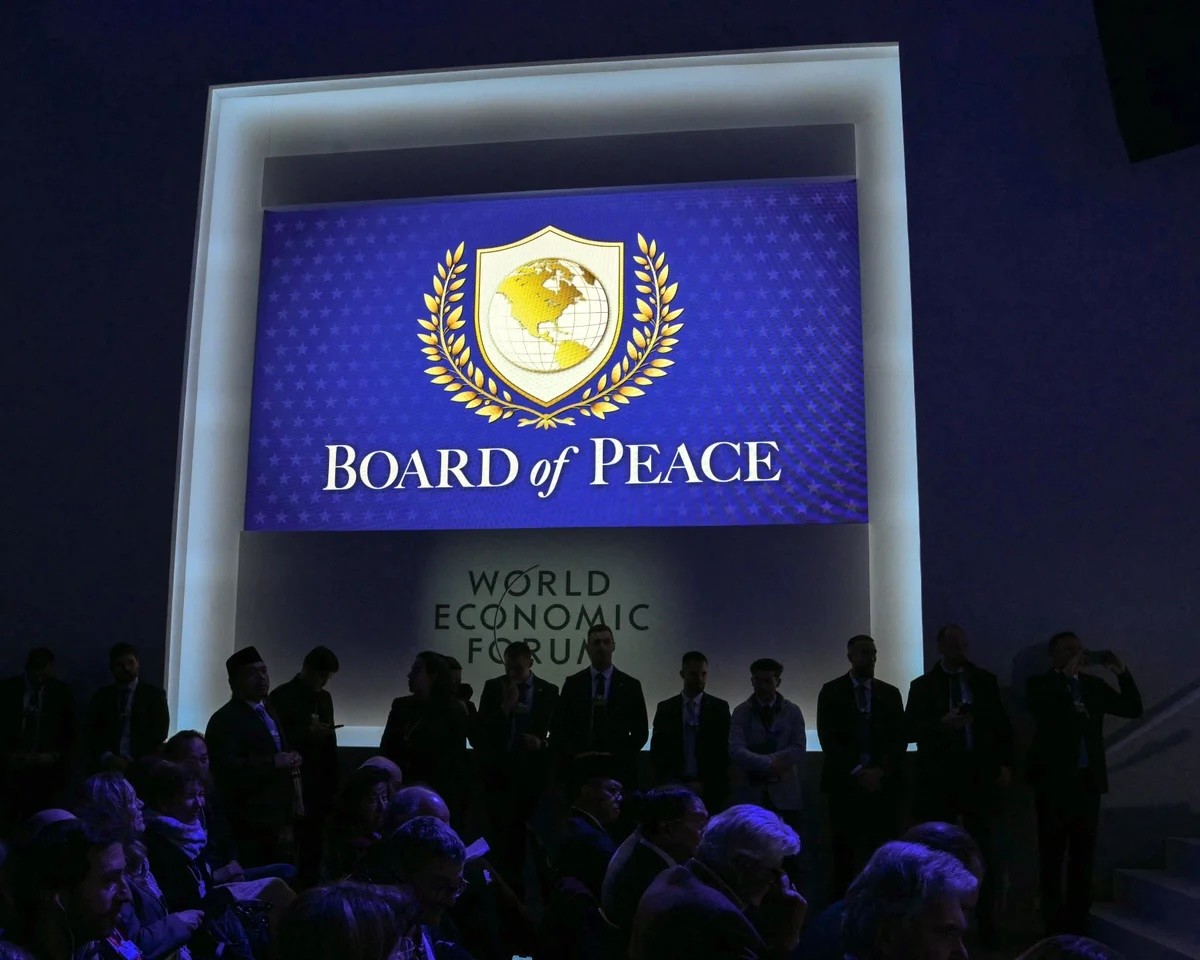
The Board of Peace Logo Isn’t a Design Problem. It’s a Disclosure.
At Davos, the “Board of Peace” unveiled a UN-adjacent seal—gold globe, olive branches, shield—that reads less like diplomacy and more like authority. Category cues, map projection, and material choices do the talking: what gets centered, what gets cropped, and what gets gilded. In a tool-rich moment, “good enough” execution becomes its own signal—symbols as posture, and branding as policy before the institution ever speaks.

Tool-Rich, Meaning-Poor: What CES Reveals About Brand Storytelling in 2026